News and perspectives

From describing diseases to reprogramming them.

Moments in the CellRewire story so far, from the founding question to the road to in vivo proof.

PublicationNovember 2026

The Art and Science of Rewiring Life: our corporate and scientific memorandum

A public edition of the document we use to explain CellRewire to scientists and investors.
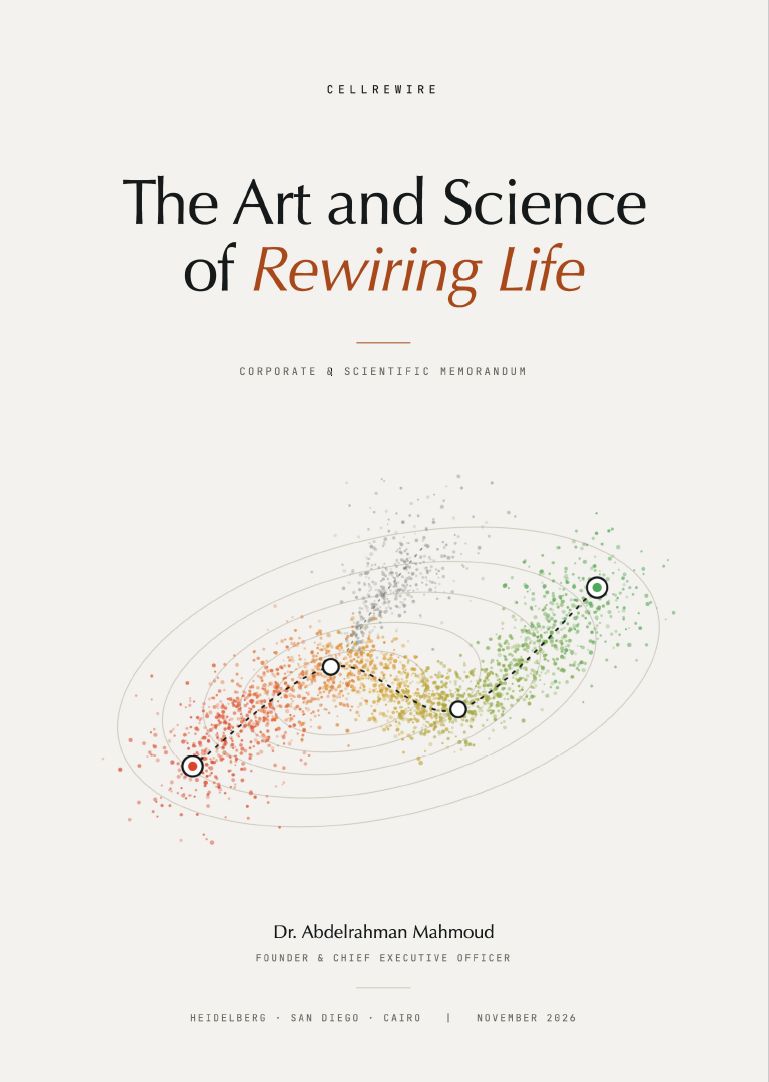
Cover of The Art and Science of Rewiring Life, CellRewire corporate and scientific memorandum, November 2026

The memorandum is written for three readers at once: the student asking how a cell decides what to become, the scientist asking what we would accept as proof, and the investor asking what twenty-four months buy.

Its central question is controllability: which cell-state transitions are reachable under exposures a patient could tolerate, and whether ordering interventions enlarges that set. It sets out the biological basis for that question, the Cell-DRL platform, our first cardiac result, and what that result does and does not show.

It also fixes, before the work begins, the gates at which the programme would stop, and places each known failure mode by severity against the stage at which it would be detected. Observation and hypothesis are kept separate throughout.

Read the memorandum (PDF, 14 pages) ↗

Informational only. This document is not an offer to sell, or a solicitation of an offer to buy, any securities, and is not medical advice or evidence of regulatory approval.


PodcastExternal episode

Predictive and reprogrammable medicine: a conversation with Abdelrahman Mahmoud

What if we could see disease coming years before symptoms, and reset failing cells back to health? Our founder talks through the science behind CellRewire.

Podcast episode with Abdelrahman MahmoudWatch on YouTube ↗

The conversation starts with a simple point. Looking at tissue in bulk averages away the cells that matter. Single-cell genomics shows the individual cells that tip a tissue toward disease, and the molecular switches that push them there.

From there, Abdelrahman explains how AI can learn the language of those cells: reconstructing how they change over time, predicting where they are heading, and proposing ways to steer them back toward a healthy state.

The episode also covers why models grounded in biological causality make more trustworthy medical copilots than off-the-shelf language models, how AI combined with lab automation can compress decades of research into weeks, and advice for young researchers: follow the fundamental questions, not just the data.

Watch the full episode and publication date on YouTube ↗
Incorporation

Why we started CellRewire

CellRewire was incorporated in 2025. The research that led to the company began earlier.

We've become very good at describing disease. We started CellRewire to see whether we could start fixing it at the level of the cell.

Dr. Abdelrahman Mahmoud
Dr. Abdelrahman Mahmoud, founder

Single-cell genomics lets us see, in remarkable detail, what individual cells are doing in a diseased tissue. During years of research at DKFZ and Heidelberg University, our founder built models that linked those cell states to how patients fared. The models got better at description. The treatments didn't change.

That gap led to a simple question. If we can map how a cell drifts into disease, can we compute a route back? Cells don't jump straight from sick to healthy. They pass through intermediate states, and those in-between states are where a well-timed intervention could do the most.

Finding those routes by trial and error would take lifetimes. So we decided to build a system that searches for them, tests what it finds in the lab, and learns from every result. That system is RewireOS.

Research perspectiveTechnology

Introducing Cell-DRL™

Cell-DRL is the reasoning engine at the centre of our platform. It learns how cells change state and proposes the smallest set of changes needed to move them.

Cell-DRL reconstructs the path from disease to health

Classical reprogramming starts from what researchers already know: pick the factors associated with a target cell type and test combinations. With around 1,600 transcription factors in the human genome, the space is enormous, and results are often inefficient.

Cell-DRL is a geometric reasoning and generative model with a reinforcement learning architecture. It treats cell identity as a geometric landscape learned from single-cell data, and generates the states along it. Given a starting point, like a scar-forming fibroblast, and a destination, like a heart-muscle cell, it plans a path and asks which interventions, in which order, would move a cell along it. It can also infer intermediate states that were never directly measured.

We designed it to favour minimal interventions, because fewer switches are easier to deliver and less likely to cause side effects. The ideas behind it are set out in our perspective paper, Reasoning Agents: Path toward Predictive and Reprogrammable Medicine, the method itself is described in the Cell-DRL preprint, and it is covered by patent application WO2025202019.

Research resultScience

Our first cardiac result: 36.1% vs 0.9%

A factor set designed by Cell-DRL turned human fibroblasts into heart-muscle-like cells about forty times more often than the established method.

cTNT⁺ cells · human fibroblasts
Cell-DRL five-factor set36.1%
hMGT standard0.9%
~40× gain over the established recipe
Mahmoud et al. 2025 · in vitro

After a heart attack, the heart heals with scar tissue that can't contract. Turning the cells that make that scar into working muscle has been a goal of regenerative medicine for years, but known recipes convert very few cells.

We asked Cell-DRL for a better recipe. It proposed five factors, none of them part of the standard cardiac cocktail. In the lab, 36.1% of treated cells expressed the cardiac marker cTNT, compared with 0.9% using hMGT.

This is an in vitro result on a single marker, not proof that a heart can be repaired. Maturity, function and in vivo testing come next. But it's the clearest sign so far that a model reasoning over cell data can find routes people have missed.

Platform perspectivePlatform

Two ways to deliver one idea

Our platform designs sequences of interventions, not single drugs. We are developing two ways to deliver them, each with different strengths.

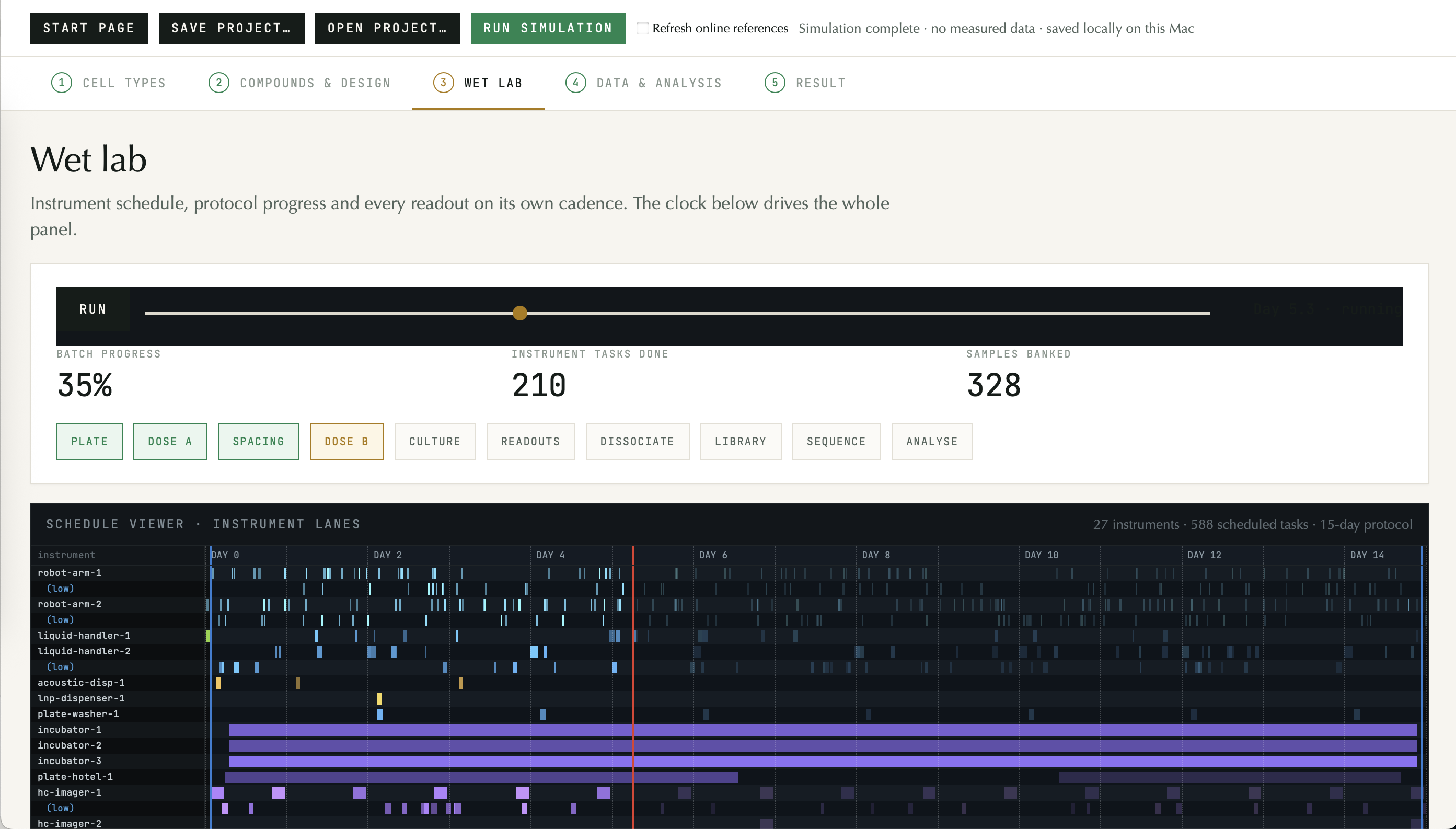
RewireOS wet lab schedule
RewireOS schedules dosing sequences, spacing and readouts

The first, sequential pharmacology, uses timed combinations of compounds that already have human safety data. The new part is the order and spacing, which is where the value and the intellectual property lie. Because the individual compounds are known, the path to first clinical studies can be shorter.

The second delivers the factor sets Cell-DRL selects as mRNA in lipid nanoparticles. This gives more direct control over cell identity, but delivery, durability and manufacturing are harder problems, so it runs on a longer timeline.

Both approaches feed the same engine. Every experiment, whichever route it uses, makes the next prediction better.

2026Roadmap

The road to in vivo

Our next milestone matters more than any other: showing that an AI-designed sequence improves function in a living disease model.

Propose, test, learn: the loop behind every cycle

We've organised the next phase around a loop. Cell-DRL proposes a regimen. We test it in a heart attack model against controls. We measure cell identity, heart function, scar size and durability. Then the results go back into the model, which adjusts the next regimen.

Four funded cycles take the lead program from a chosen combination to a confirmatory study, with safety and manufacturing work running alongside rather than after. Meanwhile, our Parkinson's and diabetes programs work toward solid in vitro data and lead constructs.

Our planning numbers are modelled, not measured, and a regulatory filing isn't an approval. We say that plainly. But the path is concrete, and each step is designed by the same engine that produced our first result.

Let's rethink medicine.

We'd like to hear from partners, investors and scientists who think cells can be repaired, not just managed.

Partner with usInvestorsCareers