Platform · RewireOS

A way to search the space of possible cells.

Most drug discovery tests one molecule against one target. We think cell identity is better understood as a landscape. Some states sit close together, others far apart, and the routes between them follow rules a model can learn. RewireOS is how we map those routes and put them to use.

How it works

Three steps, repeated.

The platform is a loop rather than a pipeline. Predictions go to the lab, results come back to the model, and the cycle repeats.

01 Predict
Disease as a film, not a photo
From single-cell data we reconstruct how cells drift from healthy to diseased. That includes intermediate states that are rarely captured, which is often where an intervention has the most effect.
02 Reprogram
The smallest set of switches
Cell-DRL™, a geometric reasoning and generative model built on a reinforcement learning architecture, plans a route back toward a healthy state and proposes the fewest genes, factors or compounds needed to follow it, along with their order and timing.
03 Validate
Experiments have the final word
Proposals are tested in cell assays and disease models. We measure identity, function and durability, and every result retrains the model.
Delivery

Two routes into the body.

A good prediction is only useful if we can act on it in a patient. We are developing two approaches in parallel, because each handles a different part of the risk.

Lane A
Sequential pharmacology
Timed combinations of compounds that already have human safety data. The novelty is in the order and spacing. Because the ingredients are known, the path to first clinical studies can be shorter, though reach into deep cell programs is more limited.
Lane B
LNP-mRNA factors
The factor sets Cell-DRL selects, delivered as mRNA in lipid nanoparticles and given in sequence. This offers direct control over cell identity and strong IP. Delivery, durability and manufacturing are harder, so it runs on a longer timeline.
In vivo loop

How we plan to learn in living models.

The same loop that works in a dish carries into animal models of disease. Four planned cycles take our lead program from a chosen combination to a confirmatory study.

01 Propose
A regimen, not a molecule
Cell-DRL suggests a combination with its order and spacing.
02 Dose
Test it in a disease model
The sequence runs in a heart attack model against controls.
03 Read out
Measure what matters
Cell identity, heart function, scar size and durability.
04 Update
Learn and adjust
Results retrain the model, which re-orders and re-times the next regimen.
Demo

RewireOS in action.

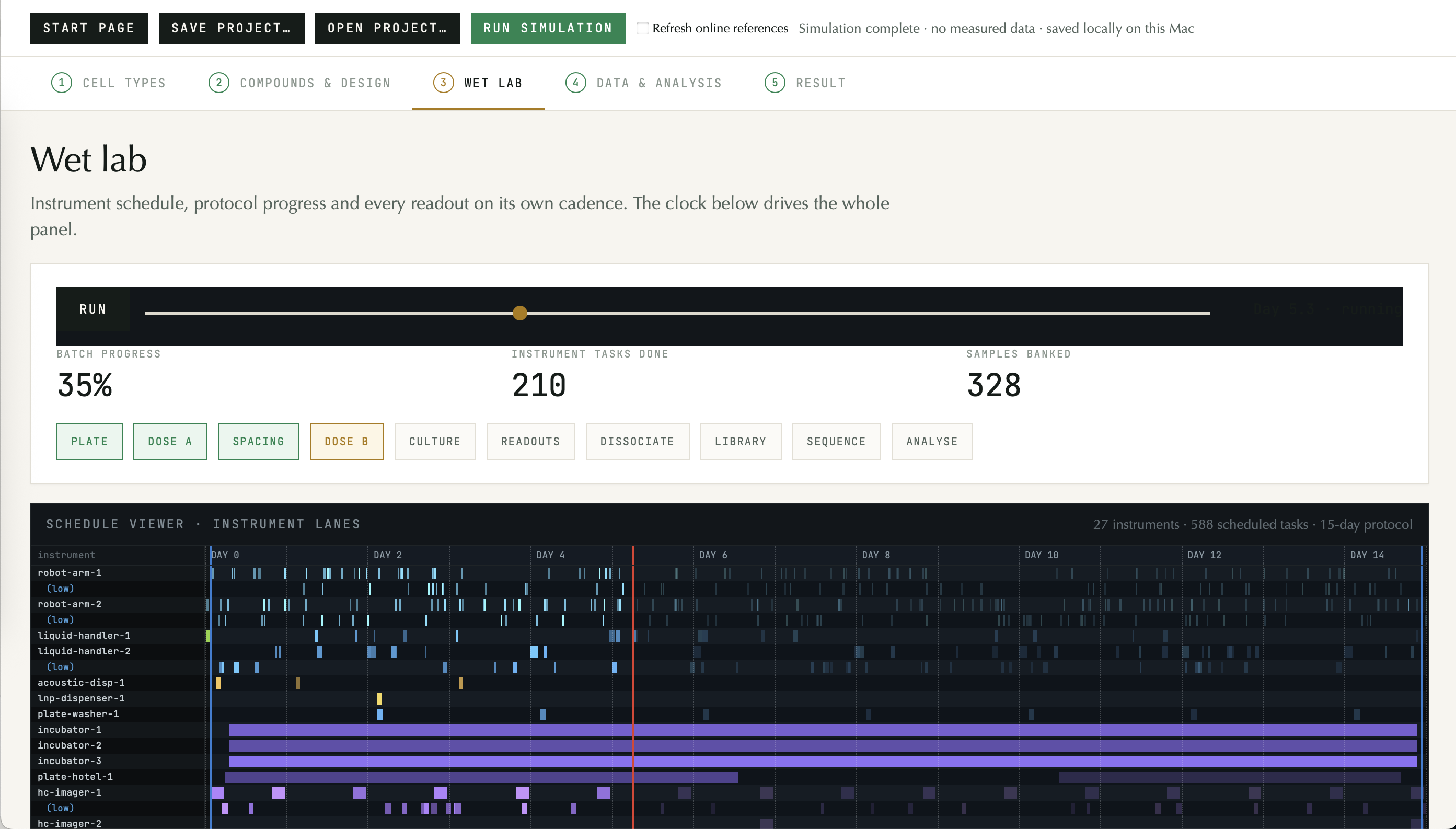
RewireOS takes you from choosing cell types and compounds, through a scheduled wet-lab protocol, to analysis and a ranked result. These screens are from the current simulation build.
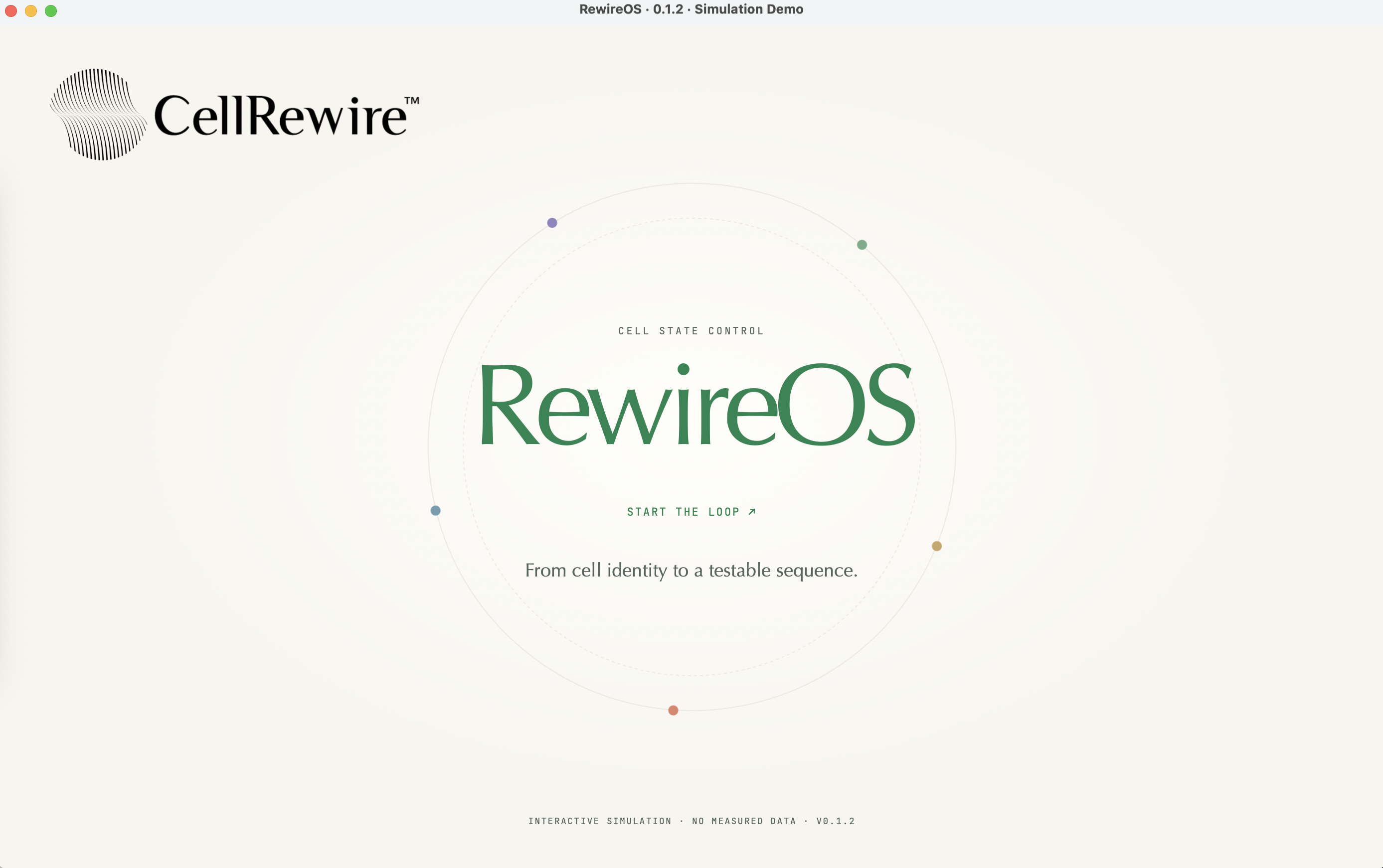
RewireOS start screen
Start the loop: from cell identity to a testable sequence.
RewireOS wet lab schedule view
Wet lab: every instrument, task and readout on one 15-day timeline.
Interested in seeing it live?
Book a 30-minute call and we'll walk you through RewireOS on a disease area you care about.
Request a demo call →

Let's rethink medicine.

We'd like to hear from partners, investors and scientists who think cells can be repaired, not just managed.

Partner with usInvestorsCareers